
Beyond the Cognitive Rubicon: Deep-Time Neanderthal Visual Cultures and the Refutation of Human Exceptionalism

Introduction
For over a century, the dominant narrative of human cognitive evolution was anchored by a teleological construct: the “Cognitive Rubicon.” This dogma posited that modern cognitive architecture—manifested through symbolic communication, abstract graphic representation, personal ornamentation, and complex spatial structuring—was a unilineal evolutionary invention exclusive to Homo sapiens. Under this paradigm, non-sapiens hominins, particularly Homo neanderthalensis, were cast as behaviorally rigid and cognitively limited, their material cultures supposedly restricted to utilitarian, survival-driven lithic strategies. When Neanderthal sites yielded perforated shells, incised bones, or mineral pigments, they were routinely dismissed as anecdotal oddities, post-depositional intrusive artifacts, or instances of uncomprehending “acculturation” triggered by contact with incoming modern human groups.
In my view, this intellectual framework was never supported by objective taphonomic or chronometric data; rather, it was a remnant of colonial-era biases transplanted into paleoanthropology. Over the past decade, a quiet empirical revolution has dismantled this exceptionalist model. High-precision chronometric applications—most notably Uranium-series (230Th/U) dating of secondary carbonate formations—alongside advanced micro-analytical techniques like Raman spectroscopy and Scanning Electron Microscopy (SEM-EDS), have fundamentally altered our understanding of the Middle Paleolithic record.
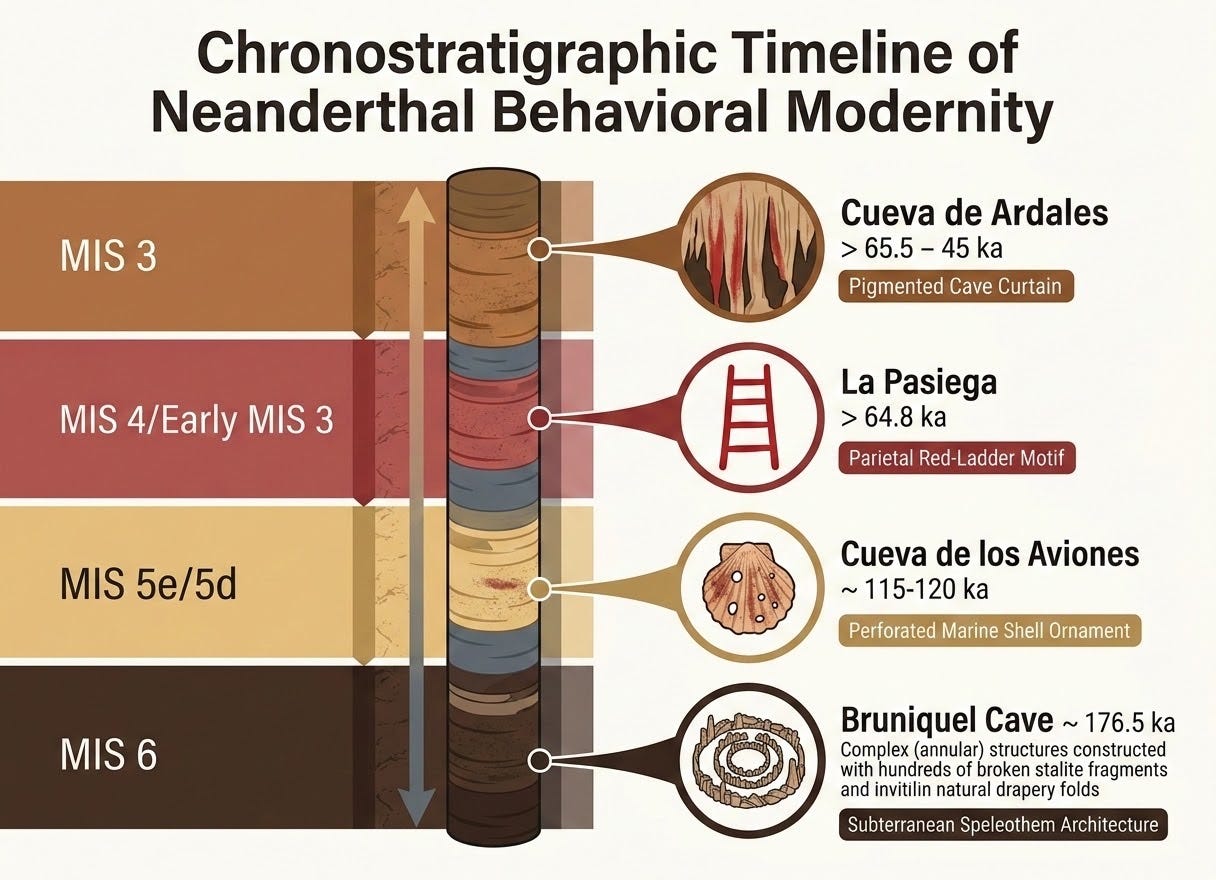
The evidence demonstrates that Neanderthals were actively engaging in complex symbolic and architectural behaviors tens of thousands of years before Homo sapiens expanded into Europe. From the dark recesses of Bruniquel Cave (176.5 ka), where hundreds of stalagmites were arranged into deliberate annular structures, to the coastal marine shell adornments of Cueva de los Aviones (115–120 ka) and the parietal red-ladder motifs of La Pasiega (> 64.8 ka), the data points to a deep-time tradition of behavioral modernity within the Neanderthal lineage.
In this article, I argue that we must abandon the “Cognitive Rubicon” entirely. In its place, we should adopt a socio-technical hybridity model that treats Late Pleistocene material assemblages not as static curiosities, but as rich cultural archives detailing a multi-lineage origin of human complexity.
Context: Site Breakdown, Stratigraphic Settings, and Lithic Technology
To evaluate the validity of Neanderthal visual cultures and complex spatial behavior, we must first situate the empirical evidence within rigorous geological, stratigraphic, and historical research contexts across Western Europe.
Cueva de los Aviones (Murcia, Southeastern Spain)
Situated on the Mediterranean coast of the Iberian Peninsula, Cueva de los Aviones is a marine karst cave whose stratigraphy preserves rich Middle Paleolithic Mousterian occupations. Excavated systematically under modern taphonomic protocols, Level II and Level III have yielded exceptional marine mollusk shell assemblages in direct association with Mousterian lithics and extinct fauna.
Early research initially assigned these levels to Marine Isotope Stage 3 (35–50 ka). However, subsequent high-precision dating of overlying flowstones and associated marine fauna pushed the age of Level III back to MIS 5e/5d, establishing a firm chronological range between 115 ka and 120 ka (Zilhão et al., 2010). This placement is crucial: it predates any documented presence of Homo sapiens in Europe by more than 70,000 years, effectively eliminating the possibility of cultural transmission from modern human populations.
Lithic Chaine Opératoire & Mousterian Technical Integration
Far from being isolated symbolic anomalies, the pigment-bearing shells and mineral lumps at Cueva de los Aviones are physically integrated into standard Mousterian lithic reduction sequences. The stone tool assemblage at Level III is dominated by local flint, quartzite, and limestone knapped using classical Levallois recurrent centripetal and unipolar core reduction methods.
Micro-wear analysis performed on retouched Levallois flakes and side-scrapers (racloirs) recovered from the same floors reveals edge-damage patterns characteristic of processing animal tissues, wood, and mechanically crushing mineral iron oxides. Grinding stones recovered alongside Specimen Aviones-1 retain microscopic red ochre residues in their surface crevices. This proves that pigment preparation was not an abstract, detached event, but an integral component of the daily Mousterian technical repertoire (chaîne opératoire).
Bruniquel Cave (Tarn-et-Garonne, Southwestern France)
Deep within the karst environment of the Aveyron Valley, Bruniquel Cave presents one of the most enigmatic subterranean archaeological structures in human evolutionary history. Discovered in 1990, the site lies over 336 meters inside the complete darkness of the cave system, far beyond the reach of natural daylight.
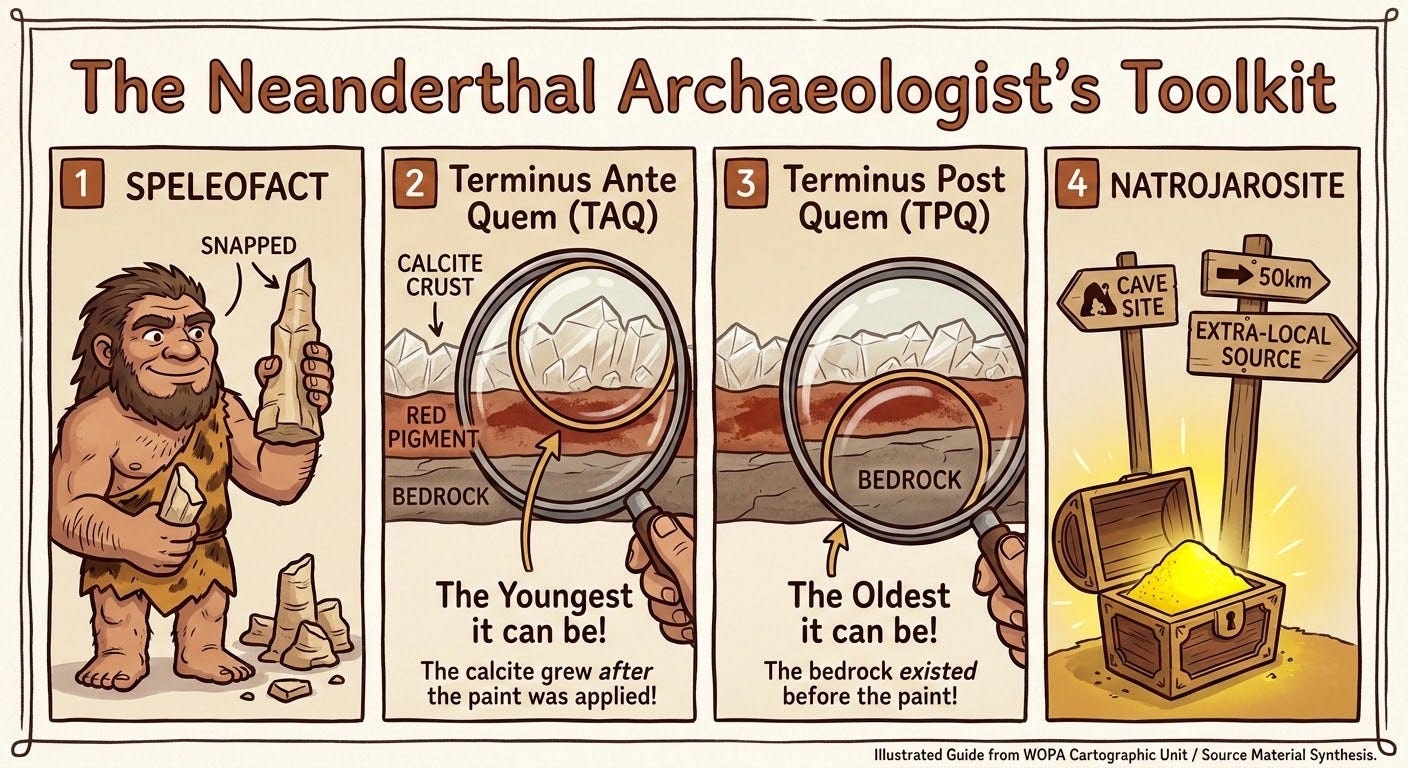
The central chamber contains two large annular (circular to oval) structures and four smaller accumulations composed of broken stalagmite fragments (speleofacts). Initial exploratory work suggested a Middle Paleolithic age, but it was not until the comprehensive restudy led by Jaubert et al. (2016) that Uranium-series dating of secondary calcite overgrowths on the stalagmite tips and broken bases yielded a definitive age of 176.5 ± 2.1 ka. The site context falls squarely into Marine Isotope Stage 6, a glacial period during which Western Europe was inhabited exclusively by early Neanderthal populations.
The Iberian Parietal Caves: La Pasiega, Maltravieso, and Ardales
The debate surrounding parietal graphic art reached a critical threshold with the systematic radiometric survey of cave art sites across Spain (Hoffmann et al., 2018):
La Pasiega (Cantabria): A central node of Monte Castillo’s subterranean karst system, containing extensive wall paintings. Panel 78 features a prominent red ladder-like motif (escaleriforme) alongside hand stencils and abstract dots.
Maltravieso Cave (Extremadura): Located in Caceres, famous for its negative hand stencils. The site stratigraphy contains Middle Paleolithic Mousterian tools, with no upper paleolithic diagnostic industry present in the basal art-bearing units.
Cueva de Ardales (Málaga, Andalusia): A massive cavern system featuring over 1,000 graphic entities. Specific focus centers on Panel II.A.3, where massive speleothem curtain formations are coated in bright red mineral pigments applied within natural drapery folds.
Methodological Foundations: Analytical Science Behind the Discoveries
Evaluating these extraordinary claims requires an understanding of the multi-disciplinary laboratory methods deployed to rule out natural geogenic anomalies, taphonomic contamination, and chronometric inaccuracies.

Uranium-Series (230Th/U) Isotope Geochronology
Radiocarbon (14C) dating is constrained by its physical decay limit of approximately 50,000 radiocarbon years, rendering it incapable of directly resolving Early and Middle Mousterian chronologies. Uranium-series dating overcomes this limitation by measuring the radioactive decay of uranium isotopes (234U) into their daughter isotope thorium (230Th). Because thorium is insoluble in water while uranium is soluble, secondary carbonate minerals (such as calcite crusts, flowstones, and stalagmites) incorporate trace amounts of uranium during their precipitation from dripping groundwater, but zero thorium.
The accumulated ratio of 230Th to 234U serves as a precision clock. To date parietal paintings without destroying the pigment, researchers utilize micro-sampling drills to extract milligram-scale calcite crusts overlying the pigment layer (providing a strict terminus ante quem, or minimum age) and calcite crusts underlying the pigment layer (providing a terminus post quem, or maximum age).
Physicochemical Pigment Characterization
To demonstrate that mineral pigments on cave walls or shell ornaments represent human agency rather than natural geogenic staining, primary researchers employ a non-destructive or micro-destructive analytical suite:
Scanning Electron Microscopy with Energy Dispersive X-ray Spectroscopy (SEM-EDS): Determines the elemental composition of pigment matrices at micron scales, enabling the identification of iron (Fe), manganese (Mn), silicon (Si), and aluminum (Al) elemental ratios.
Micro-Raman Spectroscopy: Identifies the precise mineral phase of iron oxides. This method can distinguish between hematite (alpha-Fe2O3), goethite (alpha-FeOOH), lepidocrocite (gamma-FeOOH), and magnetite (Fe3O4), providing insight into whether pigments were thermally processed or combined with organic binders.
X-ray Diffraction (XRD): Analyzes crystalline structures to characterize the mineralogical signature of ochre mixtures and distinguish local karst clays from non-local mineral imports.
Gas Chromatography-Mass Spectrometry (GC-MS): Applied to portable artifacts (such as the Cueva de los Aviones shells) to isolate organic lipid, resin, or protein residue fractions that served as paint binders or adhesive compounds.
Unlock deeper insights into human evolution with full access to rigorous, multidisciplinary site breakdowns, technical data analyses, and critical evaluations of ancient hominin cognition. By upgrading to a paid subscription, you directly support independent, primary-source science journalism while unlocking exclusive deep-dives that challenge the dogmas of deep history. Join our community of researchers and enthusiasts to read the rest of this investigation and explore the full archive.
