
Beyond the Linear Illusion: Deconstructing the 20,000-Year Hominin Coexistence Paradigm at Grotte Mandrin and the Levantine Corridor

Introduction: Breaking the “Replacement” Dogma
For decades, the dominant narrative of late hominin evolution in Western Eurasia resembled a swift, linear, and cognitively asymmetric drama. Under this classical replacement model, anatomically modern humans (Homo sapiens) supposedly crossed the Bosporus or descended from the Levantine corridor around 45 ka (thousand years ago), armed with superior symbolic thinking, projectile technology, and social networks. Within a few millennia, Neanderthals (Homo neanderthalensis) vanished into evolutionary obsolescence. Modern humans were viewed as an intellectual tide; Neanderthals, the receding shoreline.
However, recent high-resolution chronological, proteomic, and lithic analyses are systematically shattering this clean-cut, progressivist model. Rather than a swift replacement, we are looking at a messy, mosaic, and deeply prolonged regional coexistence that spanned up to 15,000 to 20,000 years across Europe and the Near East. Sites like Grotte Mandrin in the Rhône River Valley of France, Ilsenhöhle in Ranis, Germany, and key sequences in the Northern Levant like Üçağızlı Cave represent profound archaeological battlegrounds for this debate.
If Homo sapiens and Homo neanderthalensis shared the same geographic territories, seasonal migration routes, and even specific cave sites in alternating succession over a span of fifteen to twenty millennia, the “Cognitive Rubicon” separating the two species must be thoroughly re-evaluated.
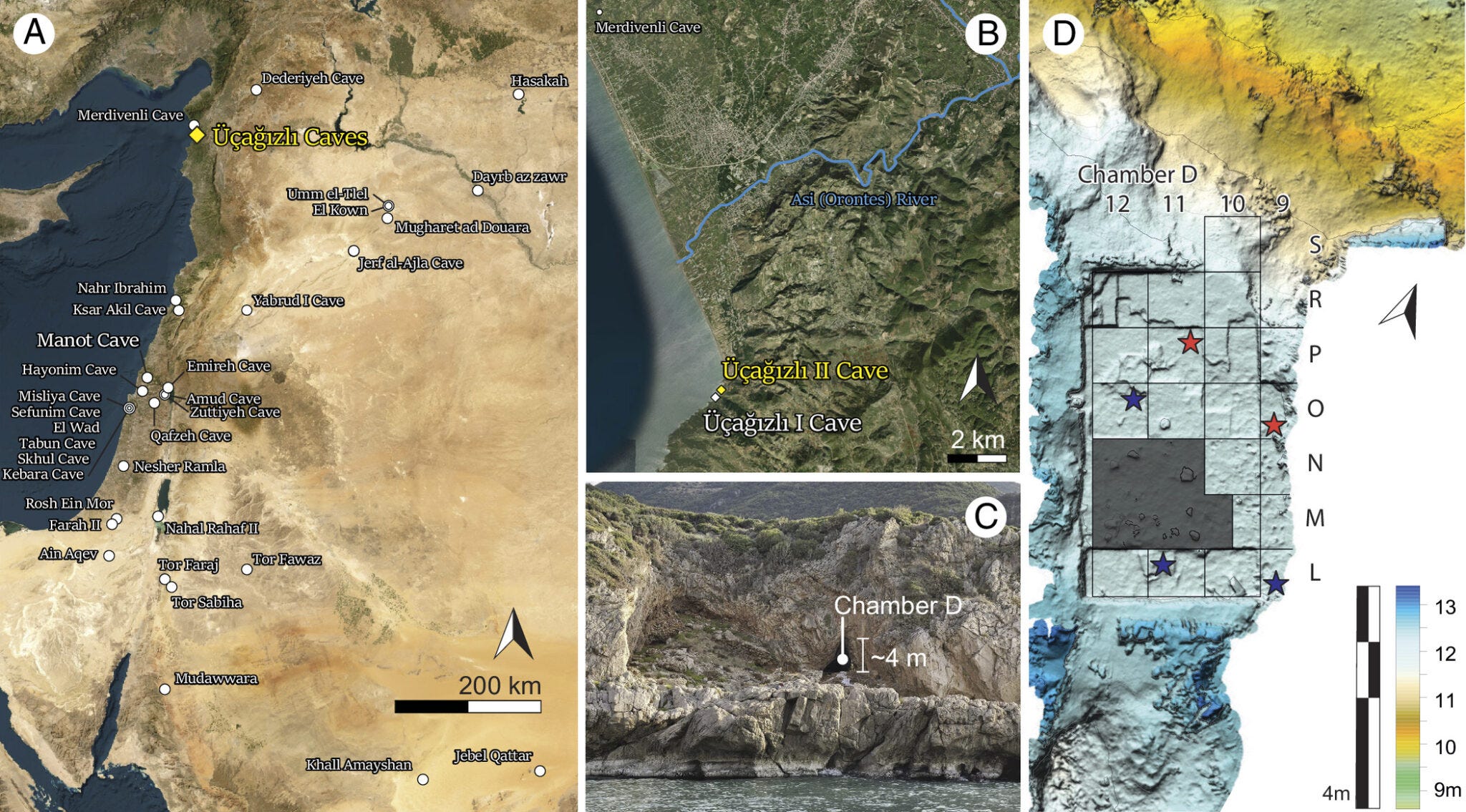
Source Map of Key Transitional Sites
To contextualize this long-term coexistence, the table below provides an overview of the key sites currently reshaping our understanding of the Middle-to-Upper Paleolithic transition:

The Rhone Valley Alternation: Grotte Mandrin’s 12-Millennia Dance
The most striking evidence for a highly structured, long-term, and local alternation of hominin populations comes from Grotte Mandrin in southern France (Slimak et al., 2022). Excavations led by Ludovic Slimak uncovered a unique stratigraphical sequence containing twelve distinct archaeological layers spanning the Late Middle Paleolithic to the Early Upper Paleolithic.
The stratigraphic progression demonstrates direct, alternating occupational successions between Neanderthals and modern humans, as broken down in the table below:

As illustrated by this stratigraphic matrix, Layer E stands out dramatically. Sandwiched cleanly between Mousterian layers (F and D) attributed directly to Neanderthals, Layer E contains the Neronian industry. This lithic assemblage is characterized by highly standardized, micro-point projectile technologies (ranging from 10 mm to 30 mm in length) manufactured using systematic, unidirectional bladelet reduction sequences. Crucially, the biological identity of the maker of Layer E was resolved by the discovery of a single deciduous upper molar (Mandrin E - hominin 1) displaying diagnostic anatomical characteristics of anatomically modern Homo sapiens.
Using high-resolution single-grain Optically Stimulated Luminescence (OSL) and accelerated radiocarbon dating of ultrafiltered bone collagen, Slimak and colleagues demonstrated that Layer E dates to approximately 54 ka. The implication is staggering: modern humans arrived in the heart of Western Europe roughly 10,000 to 12,000 years earlier than previously believed, coexisting regionally with Neanderthals in a complex pattern of alternating occupation:
Mousterian (Neanderthal) -> Neronian (Sapiens) -> Mousterian (Neanderthal) -> Protoaurignacian (Sapiens)
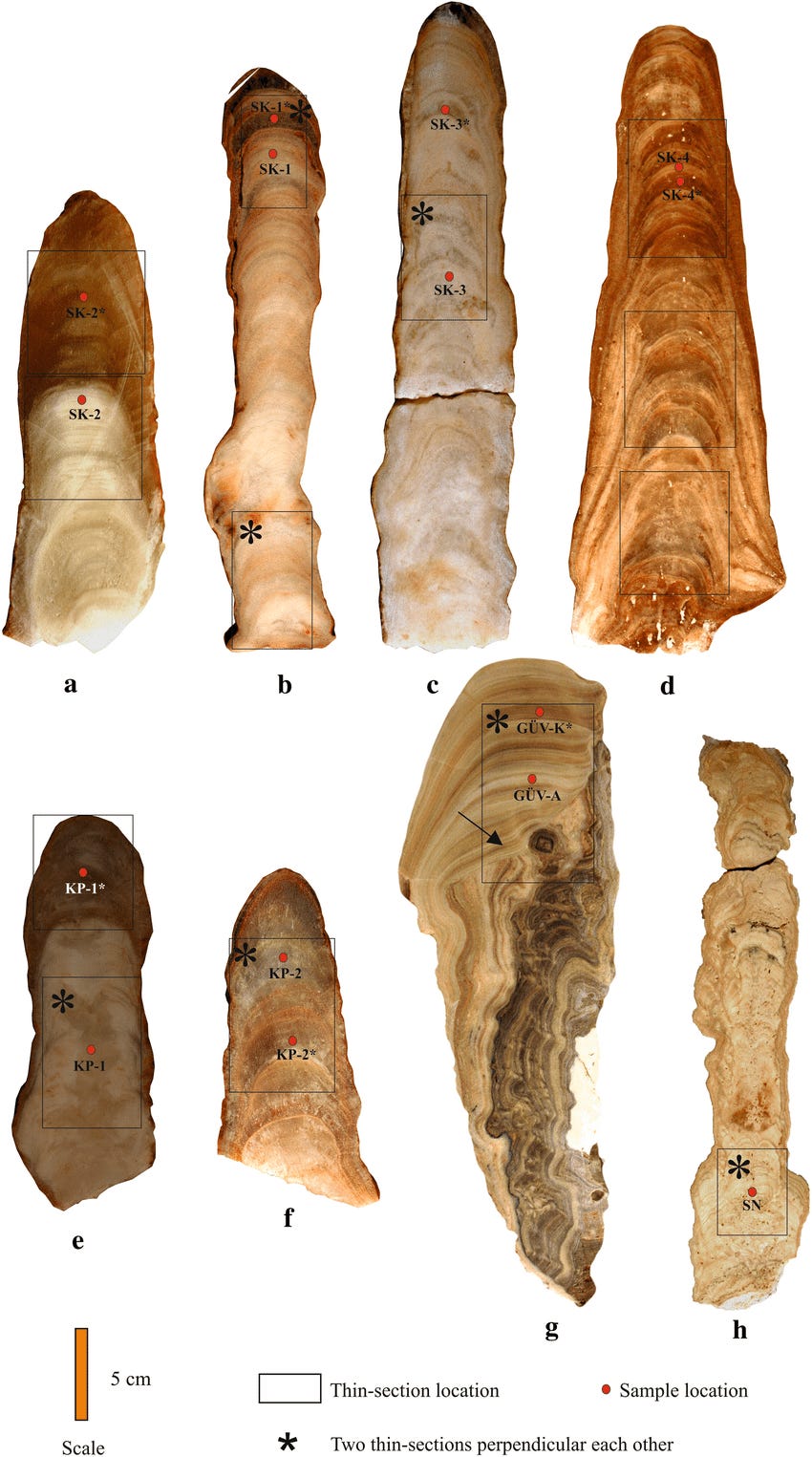
Sootslide analysis (fuliginochronology) of calcite crusts on the cave walls suggests that the transition between the modern human occupation of Layer E and the return of Neanderthals in Layer D occurred in less than a single generation—possibly within a single year (Slimak et al., 2022). This was not a slow, demographically passive process; it was a highly dynamic, competitive, or perhaps even cooperative territorial handoff.
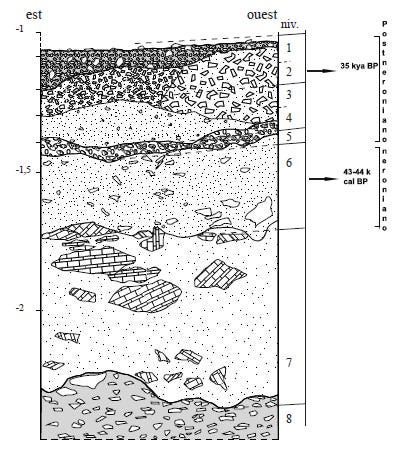
Levantine Transitions: The Northern Levant and Tinshemet Cave
To understand the deeper origin of this transitional coexistence, we must look to the Levantine corridor—the biogeographical bridge between Africa and Eurasia. At Üçağızlı Cave I in southern Turkey, research led by Steven Kuhn has documented an exceptionally rich early Ahmarian sequence dating to 41--29 ka (Kuhn et al., 2009). The site preserves some of the earliest and most complex symbolic material culture in the Upper Paleolithic, including systematically perforated marine shells (Nassarius gibbosulus) used as personal ornaments (Kuhn et al., 2001). This transition is beautifully complemented by the adjacent, newly excavated Üçağızlı II Cave sequence (Baykara et al., 2026). Spanning 77--47 ka, Üçağızlı II provides an exceptionally strong scientific bridge, demonstrating that the non-dietary marine shell tradition (utilizing Columbella rustica) was practiced by Neanderthals around 77--59 ka and seamlessly inherited or continued by incoming modern humans between 59--47 ka. This remarkable cultural continuation highlights that shared symbolic preferences and regional aesthetic traditions existed long before any Upper Paleolithic replacement occurred.
However, the chronological depths of this Levantine coexistence go back much further. At Tinshemet Cave in Israel, excavations have revealed long sequences of Levallois-Mousterian industries (Malinsky-Buller et al., 2021). The Levantine Middle Paleolithic is notoriously difficult to parse because both Neanderthals (e.g., at Amud and Kebara) and anatomically modern humans (e.g., at Qafzeh and Skhul) utilized virtually identical lithic technologies (Levallois Mousterian) for tens of thousands of years.
This technological convergence during the Marine Isotope Stage (MIS) 5 through 3 highlights that the “coexistence” in the Levant was not a brief meeting of two distinct cultural worlds, but a shared, highly adaptive socio-ecological landscape where both hominins thrived for over 50,000 years.
Technical Deep Dive: Dating, Proteomics, and Micromorphology
Proving that two hominin species occupied the same cave or region over thousands of years requires extreme scientific rigor. Simple stratigraphical association is no longer sufficient; we must account for site formation processes, taphonomy, and microscopic bioturbation.
A. Paleoproteomics via ZooMS
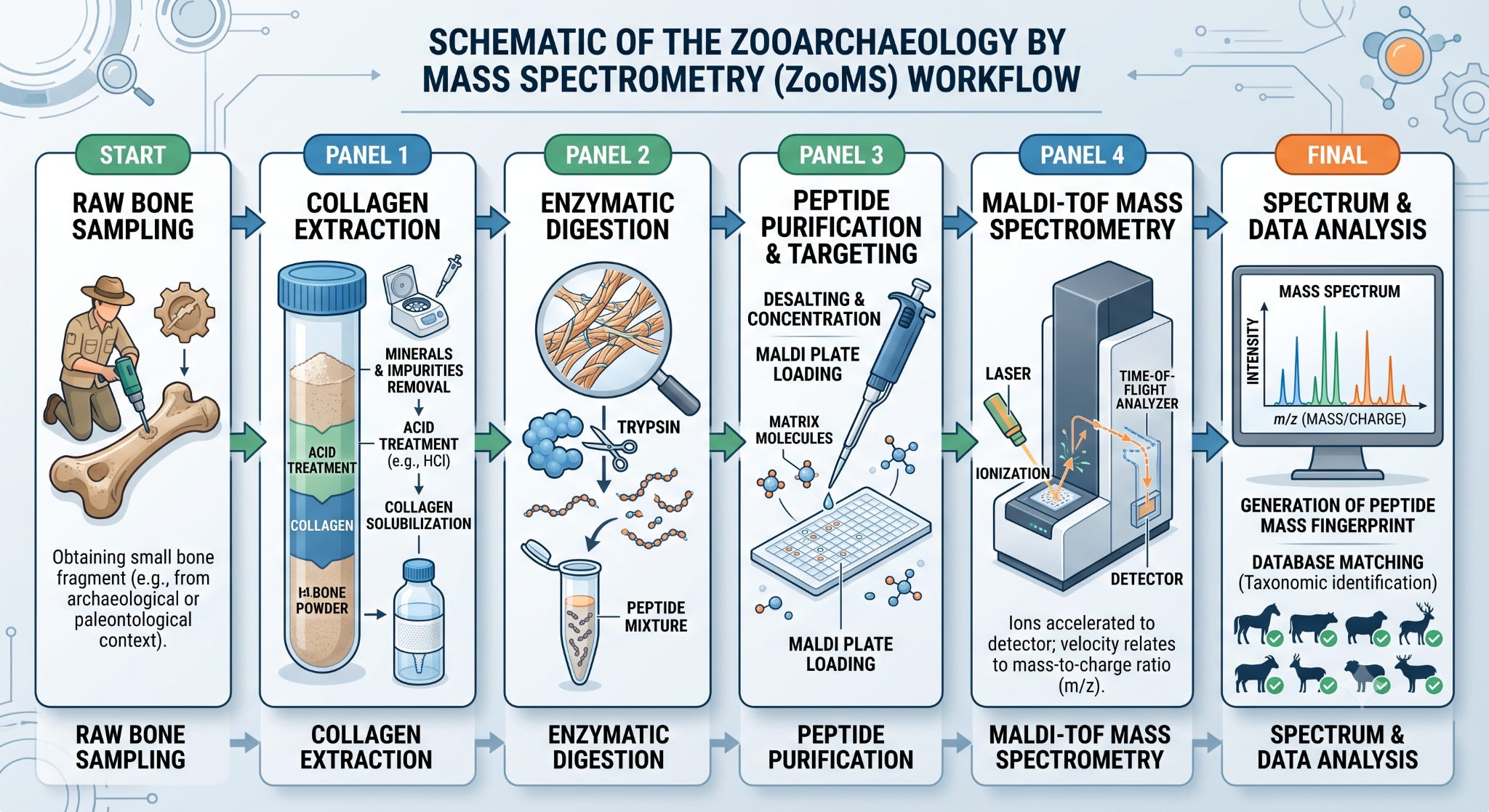
At Ilsenhöhle in Ranis, Germany, the highly fragmented nature of the osteological assembly made morphological identification of the hominin remains impossible. To resolve this, researchers utilized Zooarchaeology by Mass Spectrometry (ZooMS) (Zavala et al., 2024). By analyzing the diagnostic peptide sequences in collagen extracted from tiny bone fragments, they identified thirteen hominin specimens. Subsequent ancient DNA extraction and sequencing confirmed these specimens belonged to modern Homo sapiens carrying mitochondrial DNA lineages closely related to the Bacho Kiro populations, dating to 47.5--43.0 ka.
Rather than relying on visual representations, the systematic chemical workflow for extracting and processing taxonomic markers via ZooMS is detailed below:

Single-Grain OSL Geochronology
To avoid the averaging effects of multi-grain dating, single-grain Optically Stimulated Luminescence (OSL) measures the radiation dose accumulated by individual sand grains (typically quartz or potassium feldspar) since their last exposure to sunlight. The age is determined by calculating the equivalent dose (De) relative to the environmental dose rate (D) over the burial time (T).
Equivalent Dose (De) = Total Environmental Dose Rate accumulated over time (T)
Where De is the equivalent dose (expressed in Grays, Gy) and the dose rate reflects the environmental radiation over time. At Grotte Mandrin, this precise technique allowed Slimak et al. (2022) to date individual stratigraphic events, proving that the modern human incursion in Layer E was a discrete event at 54 ka with zero post-depositional mixing.
C. Fuliginochronology
Fuliginochronology is the study of soot layers preserved in mineral crusts (like stalagmites or flowstones) inside caves. By using high-resolution micro-computed tomography (u-CT) and scanning electron microscopy (SEM) to count individual soot laminations down to the micrometer level (e.g., 20--30 micrometers thicknesses), researchers can count the exact number of human-made fires lit in the cave over time. This technique at Grotte Mandrin proved that Neanderthals occupied the cave within years of the modern human departure in Layer E.
Authoritative Critique: Deconstructing the “Cognitive Rubicon”
The traditional model of human migration and cognitive replacement rests on a foundational bias: that modern human technology was inherently superior, and Neanderthals were cognitively inflexible.
Let us dismantle this. The Neronian bladelet technology at Grotte Mandrin Layer E (54 ka) represents a highly standardized, complex projectile technology. If this was a clear demonstration of modern human “cognitive superiority,” why did these modern humans abandon the site after a few centuries, allowing Neanderthals—using classic Mousterian scrapers and Levallois flakes—to re-occupy the cave for another 10,000 years?
The archaeological record does not show a linear march of progress. Instead, it demonstrates:
Technological Convergence: Neanderthals were fully capable of producing laminar, blade-based technologies when ecological or hunting pressures demanded it (e.g., the Châtelperronian in France or the Uluzzian in Italy).
Ecological Resilience: Neanderthals were superbly adapted to the cold, fluctuating climates of MIS 4 and 3. Modern humans, despite their standardized projectile weapons, initially struggled to maintain a permanent foothold in Western Europe.
Symbolic Equivalence: The presence of marine shell ornaments at Üçağızlı Cave (Kuhn et al., 2001) is mirrored by Neanderthal symbolic expressions, such as the use of raptor talons for personal adornment at Krapina, Croatia (Radovčić et al., 2015) and the deliberate engraving of abstract patterns at Gorham’s Cave, Gibraltar (Rodriguez-Vidal et al., 2014).
The “Cognitive Rubicon” is not a scientifically viable threshold; it is an outdated narrative of evolutionary progressivism. The reality of late hominin evolution is a complex, long-term regional coexistence characterized by cultural exchange, technological borrowing, and substantial genetic introgression. To fully appreciate this complexity, we must contrast Grotte Mandrin and Üçağızlı II. As Ludovic Slimak has observed, these two key localities showcase entirely different evolutionary dynamics. Mandrin demonstrates rapid, competitive exclusion and replacement, with modern humans introducing a finished projectile technology that had no root in the preceding Neanderthal Mousterian. Conversely, Üçağızlı II represents deep-seated behavioral and technological continuity across the species turnover, with both hominins using identical toolkits and sharing arbitrary aesthetic traditions. This spatial divergence proves there was no singular, linear cognitive trajectory across Eurasia, but rather a diverse mosaic of regional outcomes.
The Big Picture: Evolutionary and Social Implications
What does this 15,000 to 20,000-year coexistence mean for the modern human story?
First, it explains the genetic data. Recent paleogenomic studies show that all non-African modern human populations carry between 1.5%--2.5% Neanderthal DNA. Crucially, the genomes of early modern humans in Europe—such as the Oase 1 individual from Romania (dating to ~ 40 ka), who had a Neanderthal ancestor just four to six generations back (Fu et al., 2015)—reveal that interbreeding was not a rare, accidental event. It was a persistent, recurring feature of the Eurasian landscape.
Second, it implies that the cultural transition from the Middle to the Upper Paleolithic was a mutual, collaborative process. The emergence of “transitional” industries (such as the Châtelperronian, Uluzzian, and LRJ) is best understood as the result of long-term cultural transmission and technological hybridization between coexisting hominin populations.
Rather than a violent conquest, the end of the Neanderthals was likely a slow demographic assimilation, driven by fluctuating glacial climates, smaller Neanderthal population densities, and a long, drawn-out process of genetic and cultural integration.
Peer-Reviewed Bibliography
[1] Benazzi, S., Douka, K., Fornai, C., et al. (2011). Early Homo sapiens in Europe in the Chalcolithic and Uluzzian transitions at Grotta del Cavallo. Nature, 479(7374), 525–528. DOI: 10.1038/nature10484
[2] Fewlas, H., Talamo, S., Kromer, B., et al. (2020). A 14C chronology for the Middle to Upper Palaeolithic transition at Bacho Kiro Cave, Bulgaria. Nature Ecology & Evolution, 4(6), 794–801. DOI: 10.1038/s41559-020-1167-z
[3] Fu, Q., Hajdinjak, M., Moldovan, O. T., et al. (2015). An early modern human from Romania with a recent Neanderthal ancestor. Nature, 524(7564), 216–219. DOI: 10.1038/nature14558
[4] Hublin, J.-J., Sirakov, N., Aldeias, V., et al. (2020). Initial Upper Palaeolithic Homo sapiens from Bacho Kiro Cave, Bulgaria. Nature, 581(7808), 299–302. DOI: 10.1038/s41586-020-2259-z
[5] Kuhn, S. L., Stiner, M. C., Reese, D. S., & Güleç, E. (2001). Ornaments of the earliest Upper Paleolithic: New results from Üçağızlı Cave, Turkey. Proceedings of the National Academy of Sciences, 98(13), 7641–7646. DOI: 10.1073/pnas.121063298
[6] Kuhn, S. L., Stiner, M. C., Güleç, E., et al. (2009). The early Upper Paleolithic phases at Üçağızlı Cave I (Hatay, Turkey). Journal of Human Evolution, 56(2), 150–179. DOI: 10.1016/j.jhevol.2008.09.002
[7] Malinsky-Buller, A., Yeshurun, R., Ackerman, O., et al. (2021). The Levantine Middle Paleolithic sequence of Tinshemet Cave, Israel. Journal of Human Evolution, 158, 103031. DOI: 10.1016/j.jhevol.2021.103031
[8] Radovčić, D., Sršen, A. O., Radovčić, J., & Frayer, D. W. (2015). Evidence for Neandertal jewelry: Modified white-tailed eagle claws at Krapina. PLOS ONE, 10(3), e0119802. DOI: 10.1371/journal.pone.0119802
[9] Rodriguez-Vidal, J., d’Errico, F., Giles Pacheco, F., et al. (2014). A rock engraving made by Neanderthals in Gorham’s Cave, Gibraltar. Proceedings of the National Academy of Sciences, 111(37), 13301–13306. DOI: 10.1073/pnas.1411529111
[10] Slimak, L., Frouin, M., Metz, L., et al. (2022). Modern human incursion into Neanderthal territories 54,000 years ago at Grotte Mandrin. Science, 375(6582), 773–778. DOI: 10.1126/science.abj9744
[11] Zavala, E. I., Mylopotamitakis, D., Weiss, M., et al. (2024). Homo sapiens presence in Northern Europe by 45,000 years ago. Nature, 626(7998), 341–346. DOI: 10.1038/s41586-023-06923-7
[12] Baykara, İ., Turan, D., Kural, E. E., et al. (2026). Long-term cultural continuity across the Neanderthal–modern human sequence at Üçağızlı II Cave, northern Levant. Proceedings of the National Academy of Sciences, 123(29), e2609061123. DOI: 10.1073/pnas.2609061123Beyond the Linear Illusion: Deconstructing the 20,000-Year Hominin Coexistence Paradigm at Grotte Mandrin and the Levantine Corridor