
Deconstructing the “Cognitive Rubicon”: A Taphonomic Re-Evaluation of Homo floresiensis and Pyrotechnology at Liang Bua

Introduction
When the skeletal remains of Homo floresiensis were unearthed from the late Pleistocene depths of Liang Bua cave in 2003, they did not merely add a highly unusual branch to the human evolutionary tree; they shattered the prevailing linear paradigms of hominin cognitive evolution (Morwood et al., 2004). Here was a hominin standing barely 1 meter tall, possessing a cranial capacity of approximately 417 cubic centimeters—comparable to a modern chimpanzee—yet reportedly possessing the behavioral suite of an anatomically modern human: the manufacture of complex stone tools, the systematic hunting of dwarfed proboscideans (Stegodon florensis insularis), and the habitual control of fire (Morwood et al., 2005).
To reconcile this tiny brain with such advanced capabilities, early researchers invoked an extraordinary, localized reorganizational expansion of the frontal polar cortex (Falk et al., 2005). However, this intellectual move was fundamentally defensive, designed to preserve the traditional “Cognitive Rubicon”—the dogmatic anthropological assumption that “complex” behaviors such as pyrotechnology and megafaunal exploitation are exclusive hallmarks of large-brained hominins (such as Neanderthals and Homo sapiens). If a chimpanzee-sized brain could achieve identical behavioral feats, then the evolutionary link between brain expansion and behavioral complexity was deeply undermined. To protect this dogma, the initial descriptions assumed that Homo floresiensis must have been an active, big-game-hunting fire-user, forcing the archaeological interpretation of Liang Bua’s faunal remains into a predetermined, Eurocentric template of behavioral modernity.
In my view, this projection of modern human behavioral ecology onto Homo floresiensis was a profound category error. For over two decades, the field has lacked a systematic, high-resolution taphonomic analysis capable of testing these initial behavioral claims. We have operated on hand-wavey depositional associations, assuming that because Stegodon bones, micro-lithic flakes, and “burned” rodent bones were found in the same stratigraphic levels, they must represent a cohesive behavioral event orchestrated by H. floresiensis.
This long-standing empirical gap has now been decisively addressed. Writing in Science Advances, E. Grace Veatch and an international team of taphonomists have published a rigorous, multi-proxy study that fundamentally deconstructs the “big-game hunter” and “fire-using” narratives of Homo floresiensis (Veatch et al., 2026). Through a combination of controlled feeding experiments with captive Komodo dragons (Varanus komodoensis), 3D noncontact optical profilometry, multivariate Quadratic Discriminant Analysis (QDA), and massive-scale analysis of murine (rodent) burning stages, the authors present a far more nuanced, ecologically grounded reality.
Their data demonstrate that Komodo dragons, not H. floresiensis, had primary access to Stegodon carcasses at Liang Bua, leaving behind only low-utility, highly fragmented remains for the hominins to passively scavenge. Furthermore, the study reveals that there is absolutely no evidence of intentional fire use within the stratigraphic units associated with H. floresiensis; “charred” rodent remains are, in fact, the product of natural manganese staining, and the solitary burned Stegodon bone is an intrusive element from younger, Homo sapiens-bearing sediments.
Yet, as a paleoanthropologist committed to dismantling the Cognitive Rubicon, I argue that we must not interpret these findings as a “cognitive demotion” of Homo floresiensis. Instead of viewing passive scavenging and the consumption of raw meat as primitive failures, we must reframe them as highly successful, evolutionarily stable, and cognitively sophisticated strategies tailored to an insular, predator-dominated ecosystem. Co-existing as a secondary scavenger alongside the world’s largest venomous terrestrial reptile for over 100,000 years is not a sign of cognitive limitation; it is a masterclass in behavioral flexibility, risk-mitigation, and ecological plasticity.
Context: Stratigraphy, Site Formation, and Chronological Revisions
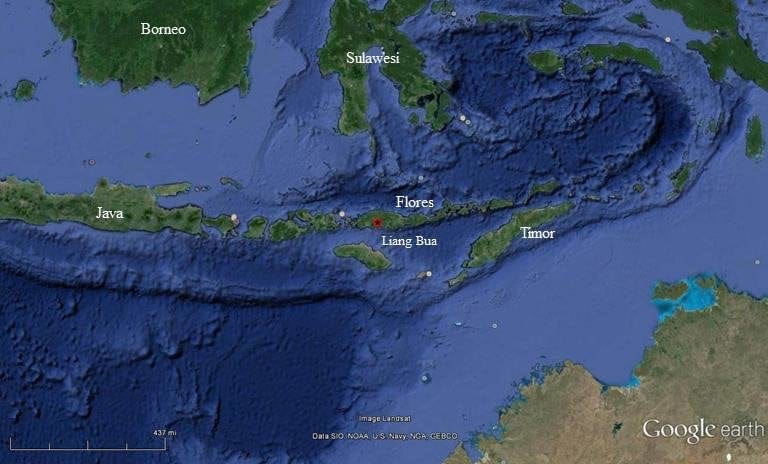
Liang Bua is a massive karst cave located in the Manggarai highlands of western Flores, Indonesia. The cave’s sedimentary sequence is exceptionally complex, characterized by rapid lateral facies changes, localized slope failures, channel cut-and-fill structures, and major stratigraphic unconformities. Understanding this geological context is absolutely essential for interpreting the taphonomic history of the site’s faunal remains.
Initially, the deposits yielding Homo floresiensis and Stegodon remains were thought to span from approximately 95 ka to as recently as 12 ka, suggesting a prolonged period of co-existence between H. floresiensis and modern humans (Morwood et al., 2004, 2005). However, a comprehensive stratigraphic and chronological re-evaluation by Sutikna et al. (2016) completely overturned this timeline. They revealed that the younger sediments (less than 20 ka) in the center of the cave were actually deposited within a massive, deeply incised erosional wash-out that cut directly into older, sloping “pedestal” deposits.
This revised chronology established that the stratigraphic units containing Homo floresiensis and Stegodon florensis insularis are strictly confined to:
Unit 1 (Subunits 1A and 1B): Dating from approximately 190 ka to 60 ka.
Unit 2: Dating from approximately 60 ka to 50 ka, capped by Tephra 3.
No skeletal or behavioral evidence of H. floresiensis exists at Liang Bua after 50 ka. Conversely, the earliest unambiguous evidence of Homo sapiens—characterized by modern human skeletal remains, advanced symbolic items (beads), complex lithic technologies, and dense hearth structures—is associated strictly with Unit 8, which dates from 11 ka to the present day, with earlier modern human traces extending back to approximately 46 ka in the adjacent, unconformably overlying units (Sutikna et al., 2018).
The physical nature of the cave sediments also played a critical role in bone preservation. The Unit 1 and Unit 2 silts and clays are highly alkaline due to the surrounding limestone bedrock, which facilitated bone preservation but also subjected the assemblages to intense post-depositional diagenesis, sediment compaction, and mineral staining. Specifically, groundwaters rich in dissolved manganese frequently precipitated black manganese oxide (MnO2) onto bone surfaces, creating dark dendritic and spotty patterns that macroscopically mimic the carbonization caused by low-temperature fires (Morley et al., 2017).
Prior taphonomic studies at Liang Bua had identified cutmarks on only three Stegodon elements (van den Bergh et al., 2008), leaving the vast majority of the proboscidean assemblage unstudied. To resolve whether H. floresiensis was indeed the primary accumulator and processor of these animals, Veatch et al. (2026) sampled 3,155 Stegodon bone fragments (representing approx. 27% of the total recovered proboscidean assemblage) from Unit 1 and Unit 2. Crucially, they also sampled 6,906 murine rodent bones from Sector XI, comparing Unit 1 (associated solely with H. floresiensis) with Unit 8 (associated solely with H. sapiens) to evaluate the presence of true pyrotechnical signatures.
Method: Replicating Predators and 3D Profilometry
The methodology deployed by Veatch et al. (2026) represents a massive step forward in quantitative taphonomy. Rather than relying on subjective visual inspections of bone surfaces, which are notorious for inter-observer bias (Blumenschine et al., 1996), the researchers built an objective, mathematically rigorous framework to differentiate hominin butchery from the feeding damage of the island’s premier non-hominin predator: the Komodo dragon (Varanus komodoensis).
To achieve this, the authors structured their methodology into four highly integrated phases:
Phase 1: The Zoo Atlanta Controlled Feeding Experiment
Because there is a near-total lack of comparative taphonomic data regarding how reptilian ziphodont (serrated, laterally compressed) teeth modify bone—most taphonomic models being based strictly on mammalian carnivores like hyaenids and felids (Pobiner et al., 2020)—the researchers conducted a controlled feeding trial. They fed a completely dressed, headless adult goat carcass (n = 72 bone elements) to a captive Komodo dragon at Zoo Atlanta.
The feeding was video-recorded to document the precise mechanical behaviors of the dragon. Following consumption, the remaining bones were carefully recovered, chemically cleaned using a mild hydrogen peroxide solution, and macroscopically and microscopically analyzed to define a quantitative baseline of Komodo dragon tooth marks (pits, scores, furrows, and microstriations).
Phase 2: 3D Noncontact Optical Profilometry
To capture the precise micro-morphology of bone surface modifications (BSMs), the researchers used a Sensofar S Neox 3D optical noncontact profilometer (Pante et al., 2017). High-fidelity silicone molds were taken of: experimentally generated Komodo dragon tooth marks (n = 72); experimentally generated hominin stone-tool cutmarks (n = 403); experimentally generated sediment-compaction trample marks (n = 130); and high-confidence, well-preserved BSMs from the Liang Bua Stegodon assemblage (n = 55).
Experimentally generated Komodo dragon tooth marks (n = 72).
Experimentally generated hominin stone-tool cutmarks (n = 403).
Experimentally generated sediment-compaction trample marks (n = 130).
High-confidence, well-preserved BSMs from the Liang Bua Stegodon assemblage (n = 55).
The profilometer scanned these molds with an exceptional spatial resolution: x- and y-axis resolution of 2.76 micron, and z-axis (depth) resolution of 70 nm.
x- and y-axis resolution: 2.76 micrometers
z-axis (depth) resolution: 70 nm
Using Digital Surf’s Mountains software, the raw 3D scans were processed to remove the underlying natural curvature of the bone, leaving a clean, three-dimensional topographic model of each mark. Eleven distinct 3D variables were extracted, including: Surface Area (micron2); Volume (micron3); Maximum Depth and Mean Depth (micron); Roughness (Ra), reflecting the friction and serration profile of the tool or tooth; Profile Angle (degrees); and the Radius of the Hole at the bottom of the transverse profile.
Surface Area (micrometers squared): The total area of the defined top plane of the mark.
Volume (micrometers cubed): The total volume of bone displaced by the mechanical agent.
Maximum Depth and Mean Depth (micrometers): Vertical penetration metrics.
Roughness (Ra): The arithmetic mean deviation of the cut’s internal walls, reflecting the friction and serration profile of the tool or tooth.
Profile Angle (degrees): The internal angle of the V- or U-shaped groove at its deepest point.
Radius of the Hole: The arc of best fit at the bottom of the transverse profile.
Phase 3: Quadratic Discriminant Analysis (QDA)
To classify the archaeological marks on the Stegodon bones without relying on human subjectivity, the authors constructed a multivariate Quadratic Discriminant Analysis (QDA) model in RStudio. QDA is a highly robust statistical classifier that models the decision boundary between different groups (cutmarks, tooth marks, trample marks) as a quadratic surface. This approach is highly suited for datasets where the covariance matrices of the predictor variables differ between groups.
The model was trained on the experimental datasets of known origin. Using a resubstitution model, the classifier achieved an overall correct classification rate of 84% (with the cross-validation model yielding 82%). Crucially, the model distinguished Komodo dragon tooth marks with a remarkable 95.8% accuracy, primarily separating them from cutmarks and trample marks based on: Width at the deepest point; Profile depth; Wall roughness (Ra); and Profile angle.
Width at the deepest point.
Profile depth.
Wall roughness (Ra).
Profile angle.
Phase 4: 2D Morphometric Analysis (ImageJ)
For highly fragile or weathered archaeological specimens that could not safely withstand the molding process, the authors developed a parallel 2D morphometric classification protocol. They captured high-resolution digital micrographs of 51 archaeological marks and compared them to a training set of experimental Komodo dragon tooth marks (n = 64) and stone tool cutmarks (n = 64) generated on white-tailed deer (Odocoileus virginianus) bones using replica Oldowan flakes. Using ImageJ, they extracted eight variables: maximum length, maximum width, area, angle relative to the bone’s main axis, perimeter, roundness, circularity, and aspect ratio. A secondary QDA model classified these 2D marks with 74% correct classification.
