
Living Archaic Legacies: Functional Denisovan Introgression and Multilineal Hominin Evolution in Oceania

Introduction
For over a century, paleoanthropology was dominated by a dogmatic linear narrative: the Cognitive Rubicon (distinct from Sir Arthur Keith’s classic anatomical brain-size Rubicon). This conceptual framework posited that the emergence of anatomically modern Homo sapiens in Africa was accompanied by a sudden, singular cognitive mutation—a neurological leap forward that bestowed unique capacities for symbolic thought, language, and behavioral flexibility. Under this paradigm, all other hominin lineages—such as the Neanderthals of western Eurasia and the enigmatic Denisovans of Asia and Sahul—were relegated to the status of evolutionary “dead ends.” They were framed as biologically and cognitively inferior populations that were inevitably swept away by the expansion of a self-contained, superior modern human species.
However, the paleogenomic revolution has thoroughly shattered this simplistic replacement model. We now recognize that the Middle-to-Late Pleistocene was characterized by a complex, braided stream of hominin lineages that frequently intersected, admixed, and exchanged genetic material (Jacobs et al., 2019; Larena et al., 2021). Rather than a clean split and replacement, the evolutionary history of modern humans is a story of profound biological and behavioral syngamy.
Nowhere is this multi-lineage reality more vivid than in Near Oceania. Comprising Papua New Guinea, the Bismarck Archipelago, and the Solomon Islands, Near Oceania represents one of the most genetically diverse and historically isolated regions on Earth. Crucially, the indigenous populations of this region harbor the highest percentages of Denisovan-derived ancestry found anywhere in the world, ranging from 3% to 5% of their total genomic makeup (Sankararaman et al., 2016).
In a landmark study, Reilly et al. (2026) have pushed this boundary further. Rather than treating archaic DNA as a silent, passive fossil within modern genomes, the researchers applied advanced functional genomic techniques—specifically, Massively Parallel Reporter Assays (MPRA)—to physically demonstrate how introgressed Denisovan alleles actively regulate modern human gene expression today. By analyzing 177 newly sequenced high-coverage genomes from Near Oceania alongside 1,284 global genomes, Reilly et al. (2026) have proven that Denisovans never truly went extinct. Instead, their genetic architecture remains a dynamic, living force that actively shapes the immune systems and skeletal phenotypes of modern Oceanic populations.
In my view, this paper represents a seismic shift in paleoanthropological theory. It demonstrates that our survival as a species was not achieved through the isolation of a “cognitively pure” lineage, but was fundamentally outsourced to, and facilitated by, the adaptive genetic packages inherited from our archaic relatives. The Denisovans did not vanish; they continue to adapt, survive, and express themselves through the biology of living humans.
Context
To understand the evolutionary dynamics of Near Oceania, one must first appreciate its unique geography, deep-time archaeological record, and demographic history. Near Oceania is divided from the Southeast Asian landmass (Sunda) by Wallacea—a transitional zone of deep-water marine trenches that have never been connected by land bridges, even during periods of glacial maxima when sea levels dropped by more than 120 meters.
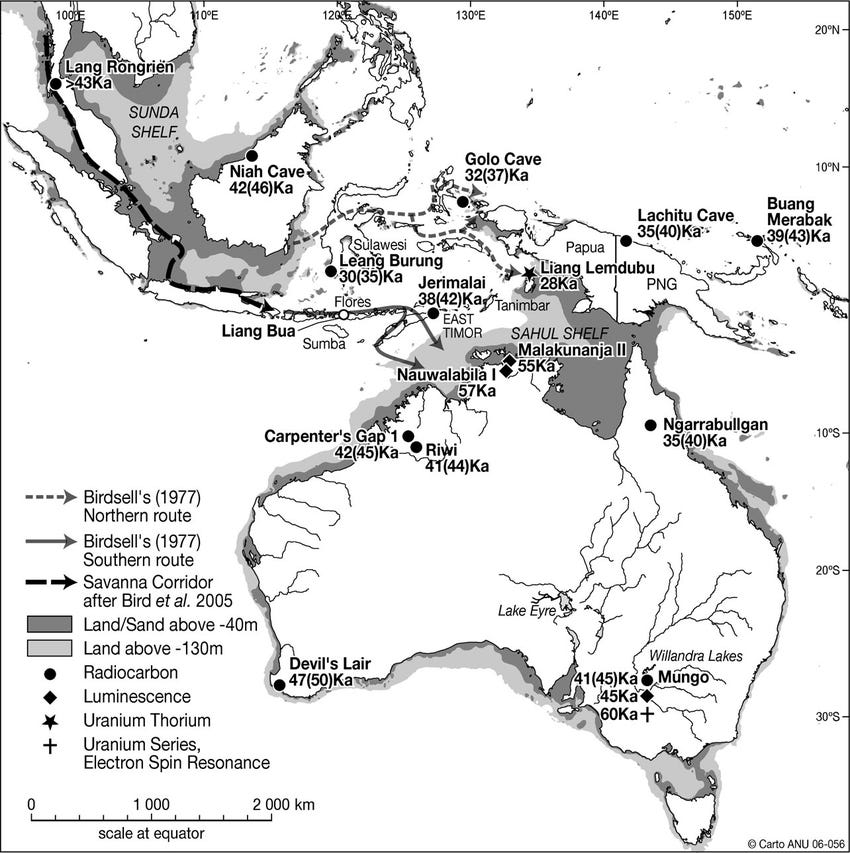
The colonization of Sahul (the combined Pleistocene landmass of Australia, New Guinea, and Tasmania) required maritime navigation across deep-water channels. Archaeological evidence from Ivane Valley in the highlands of Papua New Guinea and Madjedbebe in northern Australia establishes that modern humans successfully crossed this marine barrier by at least 45,000 to 50,000 years ago (and potentially as early as 65,000 years ago). This achievement demands a high level of cognitive sophistication, complex planning, and technological competence—direct evidence of behavioral modernity long before the classic “Upper Paleolithic Revolution” in Europe.
Upon arriving in Sahul, these early modern human pioneers encountered a landscape already inhabited, or recently influenced, by distinct hominin lineages. Genomes extracted from modern Papuans and Oceanian populations preserve a unique legacy of this encounter: a multi-layered Denisovan genomic signature. Previous research by Jacobs et al. (2019) and Choin et al. (2021) demonstrated that this Denisovan ancestry did not stem from a single, homogenous source. Instead, it represents genetic input from at least two deeply divergent Denisovan lineages, designated as D1 and D2.
The D1 lineage is highly divergent from the high-coverage “Altai” Denisovan genome sequenced from Siberia. It is estimated to have diverged from the Altai lineage approximately 350,000 to 400,000 years ago. This suggests that the southern reaches of Wallacea and Sunda were home to a distinct, highly adapted population of “Southern Denisovans” who possessed their own unique evolutionary history.
Following these initial Pleistocene settlements, Near Oceanic populations experienced profound genetic isolation. For nearly 40,000 years, these groups diverged under localized selective pressures—such as endemic tropical pathogens, high ultraviolet radiation, and rugged mountainous terrain—resulting in extreme linguistic and phenotypic diversity. This isolation was punctuated approximately 5,000 to 3,000 years ago by the Austronesian expansion. This Holocene migration brought agriculturalist populations from Southeast Asia through Wallacea into coastal Near Oceania, introducing a third wave of genetic variation and creating a complex, fine-scale population structure of Papuan-speaking highlanders, coastal lowlanders, and isolated island groups (such as the Baining of New Britain).
It is within this intricate demographic fabric that Reilly et al. (2026) conducted their investigation. Prior genomic studies heavily favored populations of European descent, leaving a critical gap in our understanding of global human genetic diversity and the functional landscape of archaic introgression. By focusing specifically on 12 diverse, underrepresented populations within Near Oceania, the researchers aimed to map the fine-scale distribution of Denisovan DNA and determine whether these inherited sequences are merely passive passenger mutations or active, functional contributors to modern human phenotypic adaptation.
To read further, please consider become a paying subscriber! We have plans for individuals, and teams! All proceeds go to helping support a Grad Student with a family in a foreign country; and supporting open access science and research!
Cheers!
