
The Generational Ghost: Persistence, Ritual, and the “Deep History” of Des Cubierta

Introduction: The Virtue of the Return
In both Stoicism and archaeology, there is a profound virtue in the return. We often think of “discovery” as a singular lightning bolt—a moment where a trowel hits a bone and the world changes. But as any researcher knows, the real work begins in the revisit. We return to the site, we return to the data, and eventually, we return to our own assumptions to see if they’ve aged as well as the fossils.
Currently, I’m looking out at a California landscape—visiting family, juggling the “now”—while my mind is halfway across the Atlantic, anchored in the Lozoya Valley of Spain. Specifically, I’m thinking about Cueva de la Des Cubierta. We’ve touched on this site before—the “Cave of the Horned Skulls”—but new spatial analysis published just this quarter (Villaescusa et al., 2026) has fundamentally shifted the “why” behind this site. It’s no longer just a “weird find”; it’s evidence of a Neanderthal tradition that lasted longer than most modern empires.
The Site: A Non-Domestic Mystery
To understand the expansion, we must ground ourselves in the foundation. Des Cubierta isn’t a “living room.” Unlike the classic Neanderthal cave sites filled with the messy detritus of daily life—butchered limb bones, discarded flint flakes, and hearth ash—Des Cubierta Level 3 is... quiet. Or rather, it was quiet, until the skulls were found.
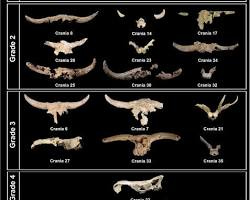
Since 2009, excavations led by Enrique Baquedano and Juan Luis Arsuaga have pulled over 35 skulls from this narrow gallery. But these aren’t just any skulls. They belong to the “titans” of the Pleistocene: steppe bison, aurochs, red deer, and even the formidable narrow-nosed rhinoceros.
The Geostatistical “Digital Trowel”
How do we know a pile of bones is a “ritual” and not just a natural accumulation? Nature is a messy architect. In a cave environment, gravity, water, and animal scavengers (taphonomic agents) create their own patterns. To claim anthropic(human-made) intent, we have to prove that the bones are where they are in spite of nature, not because of it.
This is where the 2026 Villaescusa study changes the game. The team didn’t just map the bones; they used Point Pattern Analysis (PPA) and Nearest Neighbor Analysis.
The Math of Meaning
In geostatistics, we look at the spatial relationship between points. If bones are washed into a cave by a flood, they follow a “gravity-driven” distribution—they cluster in low points or snag against rocks in a predictable, chaotic fan.
Villaescusa’s team used a K-function analysis to test for “clustering” vs. “regularity.” What they found was startling:
Selection over Scavenging: The skulls were concentrated in the “Level 3” gallery in a way that defied the natural sediment flow of the cave.
The Absence of “Snags”: Usually, large bones snag on fallen rocks. At Des Cubierta, the skulls were often placed under overhangs or in specific niches where water wouldn’t naturally deposit them.
The Rockfall Paradox: The cave roof at Des Cubierta collapsed multiple times over tens of thousands of years. The geostatistical mapping showed that despite these massive geological “resets,” the Neanderthals kept returning to the exact same spots to place new skulls.
This isn’t just a “pile.” It’s a coordinated spatial memory. They knew exactly where the “sacred” or “symbolic” space was, even after the cave’s physical layout had been altered by rockfall.
[PAYWALL PLACEMENT: The “Deep Dive” continues for paid subscribers. Below, we discuss the Lozoya Child, the ethics of the term “Prehistoric,” and the full JAS Bibliography.]
